
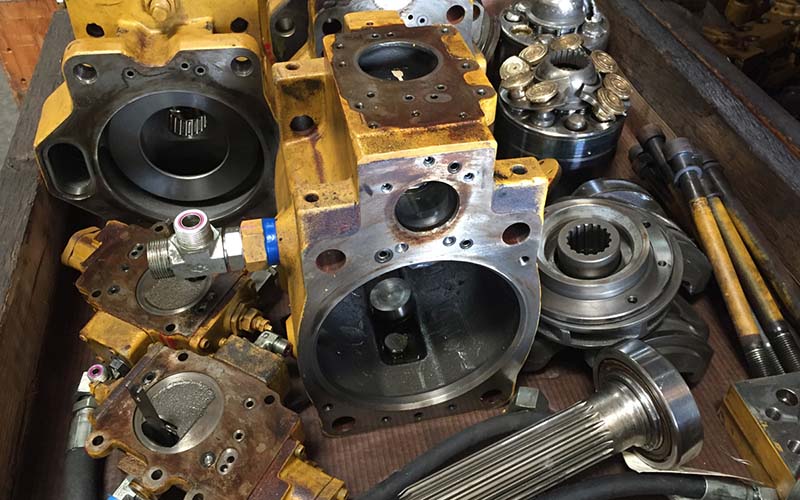
You may have heard the name hydraulic pump several times, but you might not be familiar with its functionality. In this article, we will discuss hydraulic pumps, explain what they do, and introduce you to the top sellers of hydraulic pumps.

?Who is recommended to read this article
Maybe your job is in the field of industrial products and heavy industrial machinery, or maybe you are even a heavy truck driver, we don’t know, but the position that is important is that whether you are a heavy truck driver or a purchasing manager of a company in the field of industrial machinery, or also if you are one of the sellers of 9-piston pumps or 6-piston pumps, reading this article will help you to better understand the hydraulic pump and its types.
?What is a Hydraulic Pump
In every system, there is a crucial component often referred to as the heart of the system—without it, the entire system ceases to function. In a hydraulic circuit, this vital component is the hydraulic pump. If the pump fails, the other components in the system will also be unable to operate.
Contrary to some misconceptions, a hydraulic pump does not create pressure in the circuit. Its primary function is to generate and circulate the hydraulic fluid. In other words, the pump converts mechanical energy (from electric motors, combustion engines, etc.) into hydraulic energy. In a hydraulic system, pressure is the result of resistance to the flow created at the pump’s outlet. For example, if the outlet of a positive displacement pump is open to the atmosphere, fluid will flow, but no significant pressure will develop because there is no resistance. However, if the pump’s outlet is completely blocked, theoretically infinite resistance will be created, preventing fluid movement. To protect hydraulic system components, a relief valve is essential. This valve opens when system pressure reaches a set limit, allowing fluid to return to the reservoir and preventing excessive pressure buildup.
Simply put, the flow rate of a positive displacement pump remains constant (excluding minor internal leaks) and does not depend on system pressure. Therefore, if fluid movement is restricted (due to a blocked valve or an actuator reaching the end of its stroke), or if resistance increases significantly, a pressure control valve (relief valve) must be used to protect the pump from excessive pressure.
Types of Hydraulic Pumps
Hydraulic pumps are classified into two main categories:
- Non-Positive Displacement Pumps
- Positive Displacement Pumps
Non-Positive Displacement Pumps
These pumps are primarily used in domestic applications due to their low pressure and high flow rate. They are mainly designed for fluid transfer rather than hydraulic power generation and are not commonly used in industrial settings. Their maximum pressure capacity is typically 250 to 300 psi, and they are further categorized into radial, axial, and mixed-flow pumps. Centrifugal and axial flow pumps are common examples of non-positive displacement hydraulic pumps.
Positive Displacement Pumps
These are industrial-grade hydraulic pumps widely used in hydraulic systems. In each shaft rotation, a specific volume of fluid is delivered to the hydraulic system. These pumps can handle high mechanical loads and system friction resistance.
:Types of Positive Displacement Pumps
1. Gear Pumps
- External Gear Pumps
- Internal Gear Pumps
2. Vane Pumps
- Balanced Vane Pumps
- Unbalanced Vane Pumps
3. Piston Pumps
- Radial Piston Pumps
- Axial Piston Pumps
How Positive Displacement Pumps Work
In hydrostatic systems, positive displacement pumps are used. These pumps create suction by suddenly expanding a cavity, causing hydraulic fluid to be drawn in due to atmospheric pressure. As the cavity closes, fluid is trapped at the outlet, and with continuous intake, the cycle repeats (one pump cycle is typically equivalent to one full shaft rotation). Due to their design, these pumps are tightly sealed, minimizing internal leakage. However, some leakage may still occur under high pressure, which is undesirable.
Gear Pumps
Gear pumps are divided into internal and external types.
Internal Gear Pumps
- An external driving gear is placed inside an internal ring gear.
- As the gears rotate, suction occurs, drawing fluid into the pump.
- A crescent-shaped divider ensures fluid is sealed and directed toward the outlet.
- These pumps have lower efficiency but handle fluid contamination well (due to larger tolerances).
- Maximum operating pressure: 140 to 200 bar.
External Gear Pumps
- Composed of two intermeshing gears.
- The driven shaft rotates the driving gear, which in turn rotates the idler gear.
- Fluid is trapped between gear teeth and transported to the outlet.
- Sealing is crucial to prevent fluid leakage between the gears.
Vane Pumps
- Consist of a housing and a rotor with sliding vanes.
- The rotor is connected to the drive shaft and rotates with it.
- Due to centrifugal force, the vanes press against the pump casing, creating suction.
- The fluid is trapped between the vanes and carried to the outlet.
Unbalanced Vane Pumps
- Adjustable displacement (variable flow rate).
- Due to off-center rotor placement, pressure imbalance can cause vibrations and bearing wear.
- Suitable for low-pressure applications (35-140 bar).
Balanced Vane Pumps
- Feature an oval-shaped housing with two inlets and two outlets.
- Balanced design eliminates pressure-induced vibrations, making them suitable for higher pressures (up to 280 bar).
Piston Pumps
- Use a cylinder-piston mechanism to generate flow.
- Suction occurs as the piston moves, and fluid is pushed forward during the return stroke.
- High efficiency and pressure capacity (up to 700 bar).
- Sensitive to contamination due to tight tolerances.
Radial Piston Pumps
- Pistons are arranged radially around the drive shaft.
- Centrifugal force enables piston movement for suction and discharge.
Axial Piston Pumps
- Multiple pistons are arranged parallel within a cylinder block.
- The piston stroke is adjustable, allowing flow rate control.
Non-Positive Displacement Pumps
These pumps are used in hydrodynamic systems, where fluid is propelled using centrifugal force instead of a sealed displacement mechanism. Unlike positive displacement pumps, these pumps do not create suction and require external fluid supply.
Examples:
- Centrifugal Pumps
- Impeller Pumps
Other Types of Hydraulic Pumps
Some hydraulic pumps do not fit into the traditional positive or non-positive displacement categories because of their unique operating principles. These pumps typically have no rotating or reciprocating components, making them low-maintenance but less efficient.
1. Hydraulic Ram Pumps
- Use the water hammer effect to lift fluid.
- Only moving part: a valve.
- Efficiency ranges from 75% to 90%.
2. Jet Pumps
- Utilize high-pressure fluid jets to induce suction and create flow.
- Maximum efficiency: 43%.
3. Airlift Pumps
- Compressed air is injected into a liquid, creating bubbles that carry the fluid upward.
- Common in limited applications due to high energy consumption.
Arfen Hydraulic Pumps
One of the well-known manufacturers of hydraulic pumps is Arfen. This company produces a wide range of hydraulic pump models. While we won’t cover them in this article, we recommend exploring Arfen’s product lineup if you’re interested in learning more.

One Response
Normally I do not read article on blogs however I would like to say that this writeup very forced me to try and do so Your writing style has been amazed me Thanks quite great post